Go, the functional way.
The sum types, exhaustive pattern matching, and Option types Go still doesn't have — as a language, not a library. Option/Either/Try monads, zero-reflection JSON, first-class interop with every Go module, native binaries.
sealed type Shape {
    case Circle(Radius float64)
    case Rectangle(Width float64, Height float64)
}

func area(s Shape) string = s match {
    case Circle(r)       => f"circle: ${3.14159 * r * r}%.2f"
    case Rectangle(w, h) => f"rect:   ${w * h}%.2f"
}
GALA — Go Alternative LAnguage — is a statically typed, functional-first language inspired by Scala, compiled to Go.
Safe. Ergonomic. Compatible.
The 2024 Go Developer Survey found that sum types are the #1 most-requested missing feature in Go, and Go still does not have them. GALA delivers them — and organizes everything else around three promises.
Safe — Go’s runtime bugs, caught by the compiler
Sum types with exhaustive pattern matching (an incomplete match is a build error, not a production panic), no nil (Option/Either/Try instead), immutable by default (val, immutable structs, read-only ConstPtr), always-concrete types — never a silent any — and zero-reflection typed JSON.
That extends to Go’s worst production bug class: data races are a compile error. A value crossing a goroutine boundary must be deeply immutable, and the transpiler proves it before the program runs — no sampling, no -race build, no interleaving you happened not to hit. Because GALA is immutable by default the check is silent in the common case; it fires only on genuinely mutable state (GALA-E0037).
sealed type Payment {
    case Card(Last4 string)
    case Cash()
}

func describe(p Payment) string = p match {
    case Card(n) => s"card ****$n"
    case Cash()  => "cash"
}   // omit a case and it won't compile
Ergonomic — the functional code you want to write, minus the ceremony
bind/also do-notation for composing monads, string interpolation (s"…" / f"…"), named arguments and default parameters, type inference everywhere, expression functions, and Map/Filter/FoldLeft/Collect collections. These are language features with clean syntax — not patterns bolted onto Go like samber/lo or IBM/fp-go.
func checkout(id int) Try[Receipt] {
    bind order   = fetchOrder(id)     // unwraps Try, or short-circuits
    bind payment = charge(order)
    Success(Receipt(order.Id, payment))
}
Compatible — every Go library, no bindings, native binaries
Full third-party Go interop with return types inferred directly from the Go SDK — no declaration files to write or generate. A Go (T, error) call is a Try[T] with no wrapping, the generated Go is clean and readable, and it builds to a single native binary inside your existing Go project. No runtime overhead beyond hand-written Go.
import "strconv"

// a Go (int, error) call is a Try[int]
val port = strconv.Atoi("8080").GetOrElse(80)
GALA vs Go — A Quick Look
Pattern matching is one of the most visible differences between GALA and Go. Idiomatic Go handles a closed set with a type switch, but it destructures nothing for you and never checks that every case is covered. GALA destructures values directly and enforces exhaustiveness at compile time.
GALA
val msg = shape match {
    case Circle(r)       => f"r=$r%.1f"
    case Rectangle(w, h) => f"$w%.0fx$h%.0f"
    case Point()         => "point"
}
Go
var msg string
switch s := shape.(type) {
case Circle:
    msg = fmt.Sprintf("r=%.1f",
        s.Radius)
case Rectangle:
    msg = fmt.Sprintf("%.0fx%.0f",
        s.Width, s.Height)
case Point:
    msg = "point"
}
GALA’s version is shorter, handles destructuring automatically, and produces a compile-time error if you forget a case. See the full GALA vs Go comparison for more examples including Option handling, immutable structs, and error handling.
Built with GALA: gala-tui
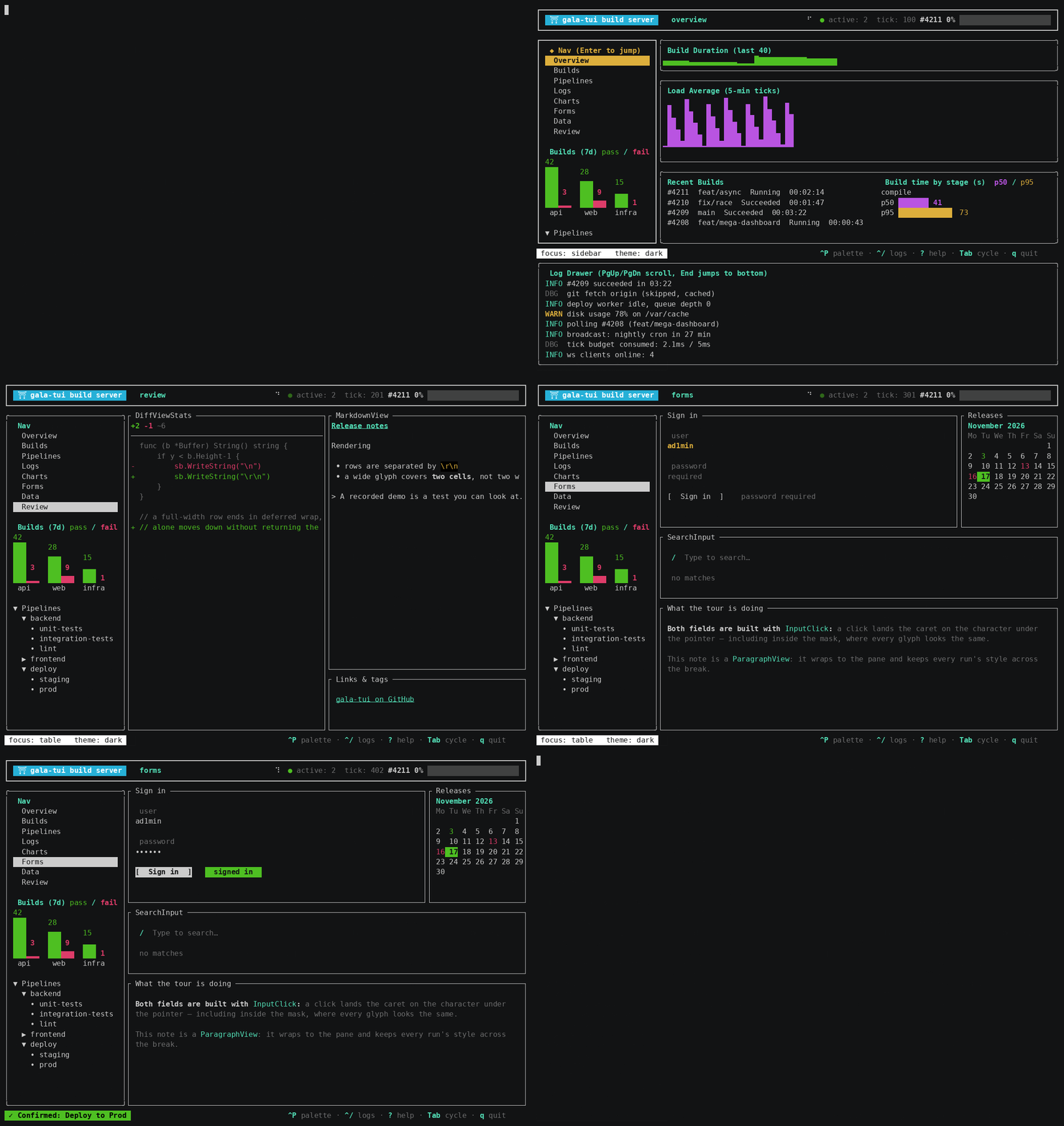
gala-tui is an Elm-architecture terminal UI framework, written from scratch in GALA. It is not a wrapper around a Go TUI library such as Bubble Tea or tview: the layout engine, differential renderer, widgets, input parsing, and async runtime are all GALA. Its only Go dependency is golang.org/x/term, for putting the terminal into raw mode. The demo above is a build-server dashboard: eight screens that between them show every widget, plus a fuzzy command palette, modals, toasts, mouse input, and four themes.
- Sealed types drive the architecture. An app’s messages are a
sealed type, soupdateis an exhaustivematch: add a message andupdatestops compiling until it handles it. Side effects are data too —Cmd[T]is a sealed type the runtime interprets. - Immutable widgets, minimal redraws. Widgets are plain immutable values, and a differential renderer writes only the cells that changed.
Futurefor async work.FutureCmdandAsyncTryrun work off the UI loop and deliver the result back as a message.- Go interop without bindings.
golang.org/x/termis imported straight into GALA, with no wrapper layer.
Run the demo yourself, or see the other projects built with GALA.
Features
Sealed Types
Define closed type hierarchies. The compiler rejects incomplete matches — no forgotten cases at runtime.
sealed type Shape {
    case Circle(Radius float64)
    case Rectangle(Width float64, Height float64)
}Built for Coding Agents
Diagnostics as JSON, every error code's reference page offline, package APIs from the terminal, and a Claude Code plugin that feeds GALA diagnostics back after every edit.
gala build --json .
gala explain GALA-E0002
gala doc collection_immutable.ArrayCompile-Time Data-Race Safety
Only deeply-immutable values may cross a goroutine boundary. A Future body that captures mutable state is a build error (GALA-E0037), not a race you find in production.
var counter = 0
Future(counter + 1)
// GALA-E0037: captures
// reassignable var "counter"Structured Concurrency & Cancellation
Future[T] composes with Map/FlatMap/Zip, and bounds itself: Cancel(), WithTimeout, and Race short-circuit pending stages instead of leaking them.
val bounded = slow
    .WithTimeout(Milliseconds(500))
.Recover((e) => 0)A Compiler That Works For You
Rust/Elm-style framed diagnostics with a caret and a fix. Panics report foo.gala:12, not generated Go. Self-tail-recursive functions become constant-stack loops.
error[GALA-E0035]: bare Go builtin
"len(...)" is not part of GALA's surface
  --> bare_len.gala:5:13
  |
5 |     val n = len(s)
| ^^^ use `.Size()`Immutability by Default
val bindings are immutable. Struct fields are immutable. Auto-generated Copy() for safe updates.
struct Config(Host string, Port int)
val updated = config.Copy(Port = 8080)Monadic Error Handling
Option[T], Either[A,B], and Try[T] replace nil checks and if err != nil with composable pipelines.
func loadConfig(path string) Config =
    os.ReadFile(path)
        .FlatMap((b) => codec.Decode(ToString(b)))
.GetOrElse(Config(Host = "localhost"))Monadic Binding (bind / also)
Do-notation for any monad. bind flattens FlatMap chains; also marks independent steps that accumulate errors (Validated) or run concurrently (Future).
func processOrder(id int) Try[Receipt] {
    bind o       = fetchOrder(id)
    bind valid   = validateOrder(o)
    bind payment = chargePayment(valid)
    Success(Receipt(o.Id, payment))
}Functional Collections
Immutable List, Array, HashMap, HashSet, TreeSet, TreeMap with Map, Filter, FoldLeft, Collect, and more.
val nums = ArrayOf(1, 2, 3, 4, 5)
val evens = nums.Filter((x) => x % 2 == 0)
val sum = nums.FoldLeft(0, (acc, x) => acc + x)Zero-Reflection JSON & YAML
Compile-time StructMeta[T] generates typed serialization with no reflection, no struct tags — for JSON and YAML alike. Builder pattern for Rename, Omit, and naming strategies.
val codec = Codec[Person](SnakeCase())
val jsonStr = codec.Encode(person).Get()
val decoded = codec.Decode(jsonStr)Regex Pattern Matching
Compile-safe regex with extractors that destructure capture groups directly in match expressions. No manual group indexing.
val date = regex.MustCompile(
    "(\\d{4})-(\\d{2})-(\\d{2})")

val shown = input match {
    case date(Array(y, m, d)) =>
        s"$y/$m/$d"
    case _ => "not a date"
}Full Go Interop
Use any Go module — standard library or third-party — with no bindings. Types come straight from the Go SDK, and a Go call returning (T, error) is a Try[T].
import "github.com/google/uuid"

// uuid.Parse returns (UUID, error)
val id = uuid.Parse(raw)
    .Map((u) => u.String())
.GetOrElse("invalid")IDE Support with LSP
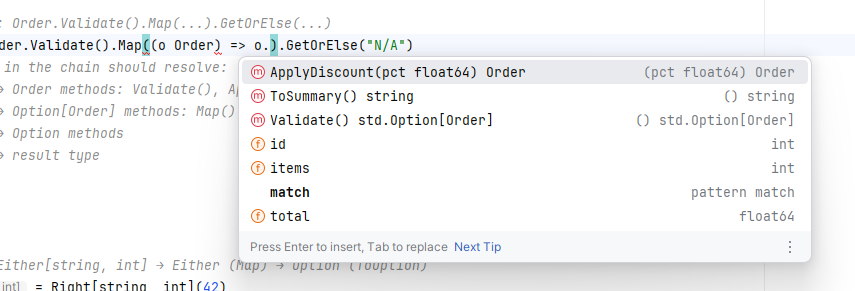
GoLand/IntelliJ plugin with syntax highlighting, type-aware dot completion, inlay type hints, and structure view. The LSP server adds diagnostics, hover, and go-to-definition — including into Go stdlib and third-party Go module sources.
Get Started in 3 Steps
1. Install
Download a pre-built binary from Releases for Linux, macOS, or Windows, rename it to gala, and put it on your PATH. GALA compiles through Go, so you also need Go 1.25+. Nix users can run nix profile install github:martianoff/gala.
2. Write
gala new hello && cd hello
Then replace main.gala with:
package main

struct Person(Name string, Age int)

func greet(p Person) string = p match {
    case Person(name, age) if age < 18 => s"Hey, $name!"
    case _                             => s"Hello, ${p.Name}"
}

func main() {
    Println(greet(Person("Alice", 25)))
}
3. Run
gala run main.gala
gala new also writes a .claude/settings.json that enables the GALA plugin for Claude Code. For larger projects, GALA has first-class Bazel rules.
See the full Getting Started guide for project setup, Bazel integration, and dependency management.
Standard Library
GALA ships with a standard library of type-safe data structures and monads, all built on sealed types and functional programming patterns.
Types
| Type | Description | Documentation |
|---|---|---|
Option[T] |
Optional values — Some(value) / None() |
Monadic types |
Either[A, B] |
Disjoint union — Left(a) / Right(b) |
Monadic types |
Try[T] |
Failable computation — Success(value) / Failure(err) |
Monadic types |
Future[T] |
Async computation with Map, FlatMap, Zip, Await, Cancel, WithTimeout |
Concurrency |
Sendable[F] |
Transparent concurrency-boundary marker — compile-time capture safety | Concurrency safety |
Validated[E, A] |
Accumulating validation — Valid / Invalid, Zip2…Zip10 |
Monadic binding |
Tuple[A, B] |
Tuples with (a, b) syntax and destructuring, up to Tuple10 |
Language spec |
ConstPtr[T] |
Read-only pointer with compile-time enforcement | Immutability |
Codec[T] |
Zero-reflection JSON codec — Encode, Decode, Rename, Omit, pattern matching |
JSON codec |
Regex |
Regular expressions with Unapply for pattern matching |
Regex |
IO[T] |
Lazy composable effects — Of, Suspend, Map, FlatMap |
IO effect |
Collections
| Type | Kind | Key Operations | Best for |
|---|---|---|---|
List[T] |
Immutable | O(1) prepend, O(n) index | Recursive processing |
Array[T] |
Immutable | O(1) random access | General-purpose sequences |
HashMap[K,V] |
Immutable | O(1) lookup | Key-value storage |
HashSet[T] |
Immutable | O(1) membership | Unique element collections |
TreeSet[T] |
Immutable | O(log n) sorted ops | Ordered unique elements |
TreeMap[K,V] |
Immutable | O(log n) sorted ops | Sorted key-value storage |
All collections support Map, Filter, FoldLeft, ForEach, Exists, Find, Collect, MkString, Sorted, and more. Mutable variants are available in collection_mutable for performance-sensitive code. See the collections documentation for details.
Documentation
| Document | Description |
|---|---|
| Language Reference | Complete reference for GALA syntax and semantics |
| All Documentation | Documentation hub — every guide and standard-library page |
| Getting Started | Installation, project setup, and first program |
| GALA vs Go | Side-by-side comparison with idiomatic Go |
| Sealed Types | Algebraic data types and closed hierarchies |
| Pattern Matching | Exhaustive matching, destructuring, and guards |
| Immutability | val, immutable structs, Copy(), and ConstPtr[T] |
| Error Handling | Option[T], Either[A,B], Try[T] monads |
| Collections | Immutable and mutable functional collections |
| Concurrency | Future[T], Promise[T], ExecutionContext, cancellation, timeouts, Race |
| Concurrency Safety | Compile-time data-race safety — Shareable, Sendable, GALA-E0037 |
| Compiler DX | Framed diagnostics, GALA-source stack traces, guaranteed TCO, use |
| Subprocess | Spawn and drive child processes, with Future-returning async methods |
| JSON Codec | Zero-reflection JSON serialization with Codec[T] |
| YAML Codec | Zero-reflection YAML serialization with the same builder API |
| Regex | Pattern matching with regex extractors |
| IO Effect | Lazy, composable side effects |
| Go Interop | Using Go libraries and types from GALA |
| Playground | Try GALA in your browser — no install needed |
Showcase Projects
| Project | Description |
|---|---|
| GALA TUI | Flagship. Elm-architecture TUI framework built from scratch in GALA, not a wrapper around a Go TUI library — immutable widgets, differential renderer, async runtime, mouse, themes |
| GALA Team | Multi-agent Claude CLI orchestrator — Team Lead delegates to Engineers and QAs, reviews work, hands you a PR. Its interface is a gala-tui app |
| GALA Server | Immutable HTTP server library with builder-pattern configuration |
| GALA Playground | Web-based playground — try it live |