IDE Support
GALA ships with a GoLand/IntelliJ plugin and an LSP server that work together to provide a full development experience. The plugin handles local features instantly (syntax highlighting, code folding, live templates), while the LSP server (gala lsp) adds type-aware intelligence (diagnostics, completion, inlay hints, go-to-definition).
Syntax Highlighting
The plugin provides rich syntax highlighting for all GALA constructs — keywords, types, string interpolation expressions, comments, operators, and built-in functions. Methods with receivers, pattern matching, and sealed type destructuring are all highlighted with distinct colors.
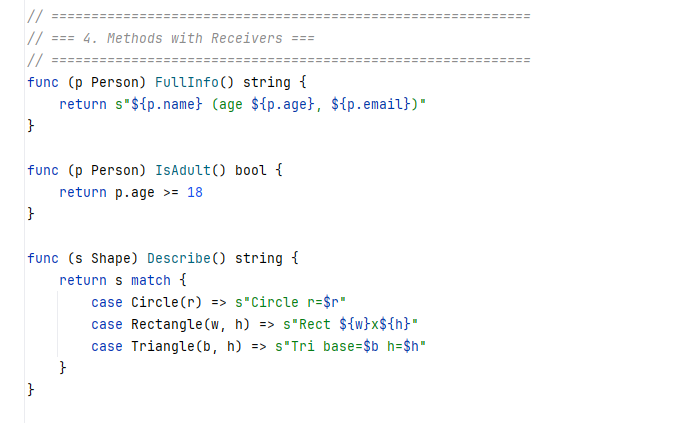
The screenshot shows methods with receivers (func (p Person) FullInfo()), string interpolation (s"${p.name} (age ${p.age})"), and pattern matching on sealed types (case Circle(r) => ...) — all with distinct semantic coloring.
Type-Aware Code Completion
After typing a dot (.), the LSP server resolves the receiver’s type and offers context-aware completions — only the methods and fields that belong to that type. Each suggestion includes the full type signature.
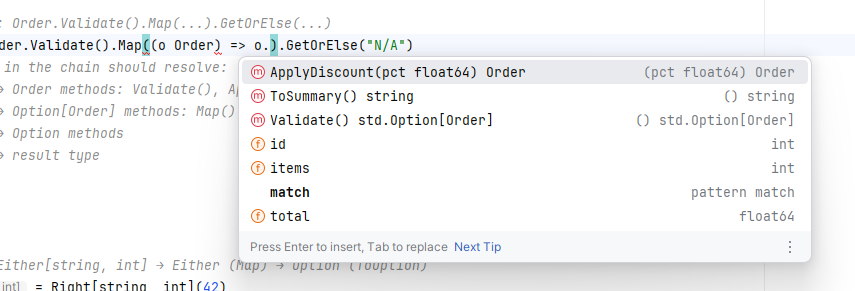
Here the cursor is inside a .Map() lambda on an Order value. The completion popup shows Order’s methods (ApplyDiscount, ToSummary, Validate) with return types, and its fields (id, items, total) — all resolved from the transpiler’s type information.
Go Interop Intelligence
Values whose type comes from a Go package used to be a dead end in the editor: no completion, nothing to click. That gap is closed — Go-backed code now behaves like GALA code.
- Go stdlib. Dot completion on a Go value (
val b = bytes.NewBufferString(...)thenb.) lists the Go type’s method set and fields. Go-to-definition on a package name, a package function, or a method navigates into the Go SDK source tree. - Cross-package return types. A call like
sha256.New()returnshash.Hash, defined in a package you never imported. The analyzer records the method set of named types reached through a function’s return values, so completion still works on the result. - Third-party Go modules. Modules such as
github.com/google/uuidresolve the same way the stdlib does: the LSP maps each module import path to its cached.gosource directory using the same logic the compiler uses, so their types get completion and their symbols get go-to-definition. go_interopand Go-only packages are navigable — imports are resolved straight from the document, so both the package name andpkg.Symbolreferences land on their declaration.
.Size() / .ByteSize() magic methods
The transpiler lowers .Size() / .ByteSize() on Go primitive receivers (string, slice, map) to len(...) / utf8.RuneCountInString(...). Those receivers carry no GALA type metadata, so the editor used to know nothing about them. The LSP now mirrors the transpiler’s rule: both resolve to int, Size() is offered on string/slice/map and ByteSize() on string, and neither raises a false diagnostic. Because these methods have no source definition, go-to-definition on them correctly resolves to nothing rather than jumping to an unrelated same-named method.
Inlay Type Hints
The LSP server displays inferred types as inline hints next to val and var declarations. These hints come directly from the transpiler’s type resolver — the same types used for code generation — so they are always accurate.
Basic declarations and tuples
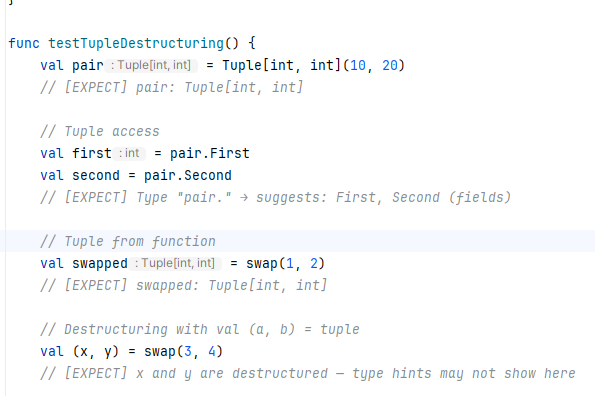
Inlay hints show Tuple[int, int] for pair declarations, int for simple values, and track types through function returns — all without explicit type annotations in the source code.
Method chains with Option types
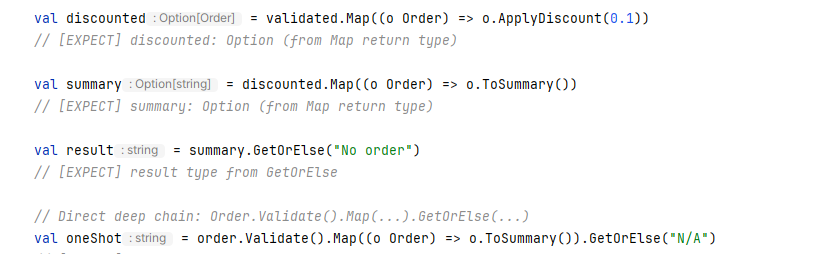
The transpiler tracks types through method chains: validated.Map(...) produces Option[Order], chaining .Map((o) => o.ToSummary()) produces Option[string], and .GetOrElse("No order") unwraps to string. Each step is visible in the editor.
Structure View
The plugin provides a structure view panel showing the outline of your GALA file — types, sealed variants, methods, and fields at a glance.
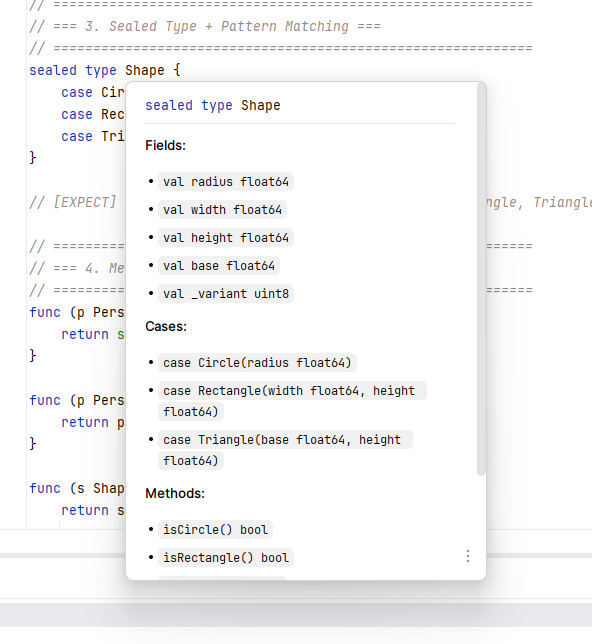
The structure view displays sealed type Shape with its variants (Circle, Rectangle, Triangle), each variant’s fields, and the auto-generated Apply/Unapply companion methods.
Full Feature List
Plugin features (local, no LSP needed)
- Full ANTLR-based parser with complete PSI tree
- Syntax highlighting for keywords, types, strings, comments, operators, built-in functions, and std types
- Semantic annotator for built-in types, std types, built-in functions, and string interpolation
- Code folding for blocks, sealed types, and imports
- Brace matching
- Structure view with functions, types, and sealed types with cases
- Comment/uncomment
- Color settings page
- Keyword support for
use(scoped-resource binding) andbind/also(do-notation), with the bound name clickable, renameable, and find-usages-aware - 13 live templates:
func,val,var,match,if,ife,for,sealed,struct,lambda,main,println,sinterp
LSP features (via gala lsp)
- Diagnostics — parse errors, transpilation errors, unused variables, match exhaustiveness, and the surface guardrails: bare Go builtins (GALA-E0035) and bare Go statement keywords such as
defer(GALA-E0036) - Hover — inferred types and signatures with fields, methods and sealed cases, plus the declaration’s doc comment — for your own code and the standard library
- Go to Definition — cross-file (including the files of a multi-file
mainprogram), local declarations, pattern bindings, named arg fields, Go stdlib and third-party Go module sources,go_interopand other Go-only packages - Find References — usages of a name across all files of its package
- Signature help — the parameter list and documentation of the call you are typing, with the active argument highlighted
- Completion — type-aware dot completion (GALA and Go types) with each item’s documentation, named arguments, sealed case patterns, keywords including
use/bind/also, and.Size()/.ByteSize()on Go primitives - No dead ends — the E0035-forbidden builtins (
len,append,make,panic, …) are filtered out of completion against the transpiler’s own authoritative list, so the editor never suggests code the compiler rejects - Inlay hints — compiler-inferred types for all
val/vardeclarations - Document symbols — the file’s own types, sealed variants, methods, functions and package-level vals, at their exact positions
- Workspace symbols — search declarations by name across every
.galafile in the project - Debounced analysis — 500ms delay after last keystroke to prevent noise while typing
Installation
GoLand / IntelliJ IDEA
- Install the GALA CLI from releases and add it to your PATH
- Install the plugin: Settings > Plugins > Install from Disk > select
gala-intellij-plugin.zipfrom releases - Restart the IDE — the LSP server starts automatically when you open a
.galafile
VS Code
There is no dedicated GALA extension yet. Use a generic LSP-client extension and register gala lsp for .gala files; the exact settings key depends on the extension you pick, for example:
{
  "lsp.servers": {
    "gala": {
      "command": "gala",
      "args": ["lsp"],
      "filetypes": ["gala"]
    }
  }
}
Neovim
require('lspconfig.configs').gala = {
  default_config = {
    cmd = { 'gala', 'lsp' },
    filetypes = { 'gala' },
    root_dir = require('lspconfig.util').root_pattern('gala.mod', '.git'),
  },
}
require('lspconfig').gala.setup({})
Claude Code
The GALA plugin connects Claude Code to gala lsp, so an AI agent editing .gala files uses the same analysis as your editor:
- Diagnostics after every edit. Parse errors, non-exhaustive matches and other transpiler errors are pushed into Claude’s context right after it changes a file, so it fixes them without running a build.
- Hover, go-to-definition and find references. Claude looks up inferred types and declarations instead of guessing them.
- A skill that steers Claude to the language server. It edits
.galafiles with the tools that report diagnostics and finds standard library methods through definitions and symbols instead of grepping.
The plugin starts the gala binary but does not include it. Install the GALA CLI first (see Getting Started) and check that gala version works in the terminal you start Claude Code from. Then run in Claude Code:
/plugin marketplace add martianoff/gala
/plugin install gala@gala
Projects created with gala new include a .claude/settings.json that declares the marketplace, so Claude Code installs and enables the plugin once you trust the project folder.
If gala is not on the PATH, Claude’s LSP tool fails with Command 'gala' not found and no GALA diagnostics reach it. Diagnostics cover what the GALA transpiler checks; errors that only the Go compiler finds in the generated code still need gala build. Full instructions: ide/claude-code.
Verify
Run gala lsp in a terminal. It should start and wait for JSON-RPC messages on stdin/stdout. If you see no output and no errors, the server is running correctly.