Go, the functional way — and the feedback loop an AI coding agent actually wants.
GALA for AI — the compiler is the agent’s feedback loop
A coding agent is only as fast as its feedback signal. It works in discrete generate → check → fix turns, and the quality of “check” decides how many turns it burns to reach correct code. GALA’s compiler turns whole classes of bugs into an instant, precise, deterministic error at the exact edit site — no test harness, no lucky code-path coverage, no runtime surprise.
This is not a claim that GALA writes better code. It’s a claim about loop economics: where the error surfaces, how precise it is, and whether the agent has to run the program to discover it.
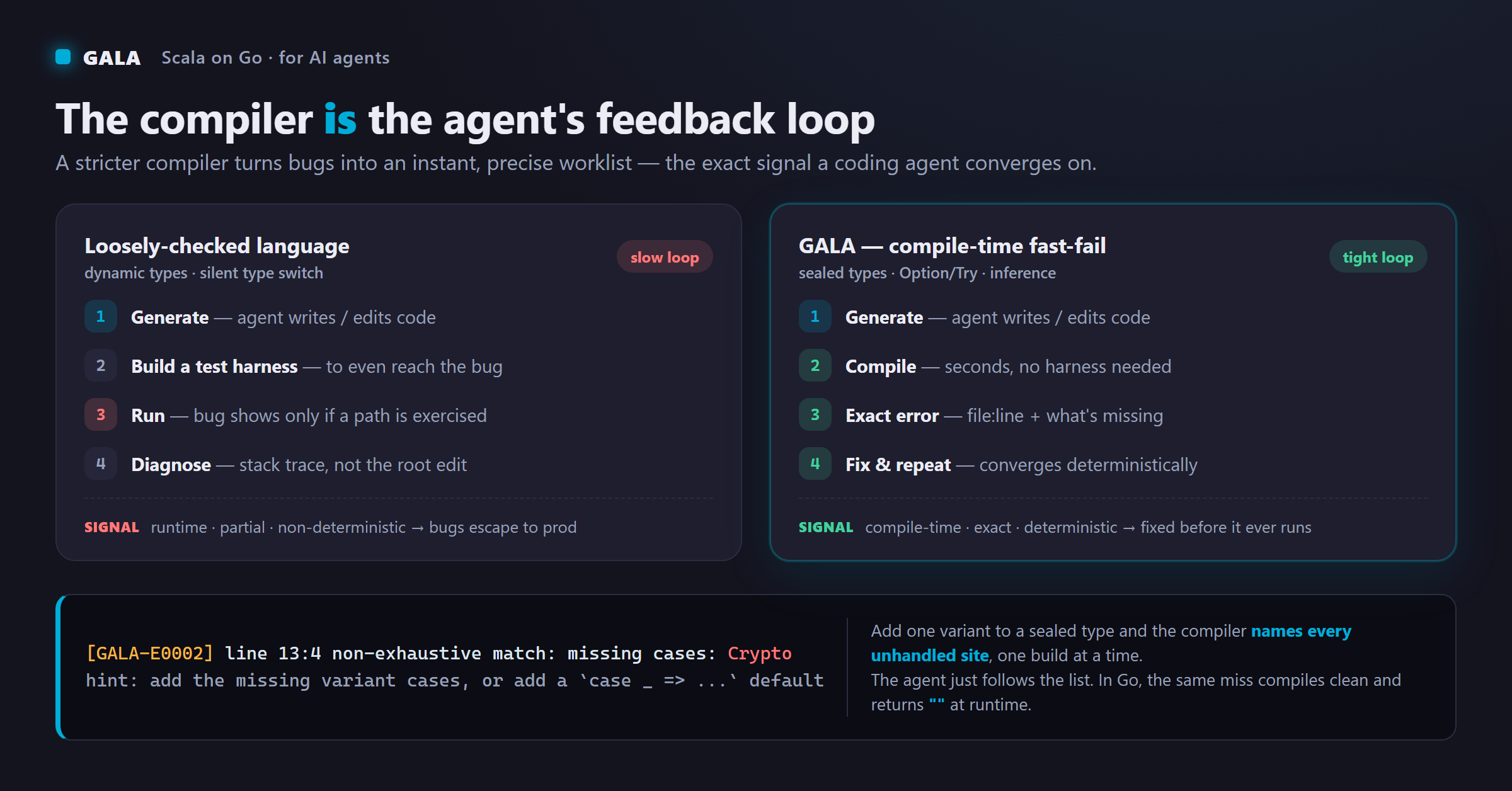
Why this matters for agents specifically
Human developers tolerate a loose feedback loop because they hold context in their heads. An agent doesn’t — every turn that requires running code costs more than a turn that only requires compiling it.
| Loosely-checked language | GALA (compile-time fast-fail) | |
|---|---|---|
| Where the bug shows | runtime, only on an exercised path | build time, always |
| To even reach it | write and run a test harness | just gala build |
| Precision | stack trace at the symptom | file:line at the root edit + what’s missing |
| Determinism | flaky / path-dependent | same input → same error |
| Escapes to prod | yes, if untested | no — it will not compile |
Fewer turns per fix, and no “did my test actually cover that path?” gamble. The compiler is a free, exhaustive reviewer the agent can call on every turn.
The demo: extend a closed set
The single most common refactor an agent performs is extending a closed set —
“add a Crypto payment method.” Here a sealed type is matched on in three places.
The agent adds the variant and forgets the match sites — the realistic mistake.
GALA — compiler hands you a worklist
sealed type Payment {
    case Card(Last4 string)
    case Cash()
    case Bank(Iban string)
    case Crypto(Chain string)  // agent added
}

// three match sites now incomplete
func label(p Payment) string = ...
func fee(p Payment) float64  = ...
func requiresName(p Payment) bool = ...
Go — compiles clean, ships the bug
type Payment interface{ isPayment() }
type Card struct{ Last4 string }
type Cash struct{}
type Bank struct{ Iban string }
type Crypto struct{ Chain string } // added

func label(p Payment) string {
    switch v := p.(type) {
    case Card: return "card ****" + v.Last4
    case Cash: return "cash"
    case Bank: return "bank " + v.Iban
    }
    return "" // Crypto silently lands here
}
Run each build. GALA fails, and names the exact site and the missing variant — one precise task per build, until green:
$ gala run main.gala
error[GALA-E0002]: non-exhaustive match: missing cases: Crypto
  --> main.gala:11:5
   |
11 |     case Card(n) => "card ****" + n
   |     ^^^^ add the missing variant cases, or add a `case _ => ...` defa…
   |
   = hint: add the missing variant cases, or add a `case _ => ...` default to cover them

# fix label(), rebuild → main.gala:18:5 (fee)
# fix fee(),   rebuild → main.gala:25:5 (requiresName)
# fix all three         → compiles, runs
An agent doesn’t need to parse that frame. gala build --json returns the same
diagnostic as data, with a link to the code’s reference page (also available
offline through gala explain GALA-E0002):
{
  "diagnostics": [
    {
      "severity": "error",
      "code": "GALA-E0002",
      "message": "non-exhaustive match: missing cases: Crypto",
      "hint": "add the missing variant cases, or add a `case _ => ...` default to cover them",
      "file": "main.gala",
      "line": 11,
      "column": 5,
      "docsUrl": "https://gala.fyi/docs/errors/gala-e0002/"
    }
  ]
}
Go compiles the same mistake with no error and no warning, and
label(Crypto{"eth"}) returns "" at runtime — forever, unless a test happens
to pass a Crypto value through label and assert the result. The agent would
have to predict the exact bug in advance. Dynamically-typed languages are worse:
the mistake hides until that line executes in production.
(The transcript above is real output from GALA — the compiler stops at the first incomplete site, so each build is a deterministic step toward green.)
Which features feed the loop
Exhaustiveness is the flagship, but the same runtime → compile-time shift runs through the language. Each one is another class of bug the agent is told about for free, instead of having to discover by running code:
- Sealed types + exhaustive
match— extend a closed set, get a complete worklist of every site to update. Option[T]/Try[T]instead ofnil/(T, error)— “forgot the empty or error case” becomes a type error, not a nil panic three calls deep.- Immutability by default — “accidentally mutated shared state” stops compiling instead of becoming a heisenbug the agent can’t reproduce.
- Type inference with no silent
any— an unresolved type is a hard error at the edit, so the agent can’t paper over a mistake withinterface{}. - Compile-safe regex and typed JSON
Codec[T]— malformed patterns and shape mismatches fail the build, not a request handler.
Every one converts a “write a test and hope” turn into a “read the compiler” turn.
Honest limits
- The compiler proves shape and totality, not logic. It guarantees the agent
handled the
Cryptocase; it can’t know the fee should be0.015. Agents still need tests for behavior. - This helps most on refactors and structural change — the work agents do constantly — and less on greenfield logic.
- GALA transpiles to Go, so runtime speed is unchanged. The win is entirely in the authoring loop, not execution.
- It’s a real compile step. For throwaway one-liners, a dynamic REPL loop is still faster.
Try it
- Playground — run GALA in your browser, no install
- GALA vs Go — the same comparison across sum types,
Option, immutability, and errors - Getting Started — install and write your first program
- Claude Code plugin —
gala lspdiagnostics reach the agent after every edit, before any build - Sealed Types · Pattern Matching — the exhaustiveness that drives the loop
AI policy
GALA is open to AI: crawlers, AI search, model training, and AI-assisted pull requests are all welcome — see the AI policy.